How to Background-Check a C-Suite or Board Hire
To background-check a senior hire, verify their claimed titles and tenures against the record, review their governance history for how they handled crises, check for litigation and regulatory actions, and run FCRA-compliant, consent-based reference calls — with former direct reports, not just the offered names. A bad C-suite hire is a governance failure, not just an HR one.
Why is executive vetting a board-level responsibility?
A senior hire controls capital, culture, and disclosure, and the cost of getting one wrong is measured in quarters, not weeks. Executive-search data has long put failure rates for senior external hires uncomfortably high — a widely cited body of work finds that a large minority of new executives fail or leave within eighteen months — and each failure resets strategy and morale. Directors carry a duty of care for the process, which is why executive diligence goes deeper than a standard employment screen.
The verifiable spine — titles, tenures, board seats — is checkable. The harder, higher-value work is reconstructing judgment: how the candidate behaved when an organization they led was under pressure. As Peter Drucker observed, "Executives who make effective decisions know that one does not start with facts. One starts with opinions" — and a candidate's decision record reveals which opinions they held when it counted.
How do you verify titles, tenure, and board history?
Claimed roles inflate, and at the senior level the inflation is often subtle — a "co-founder" who joined in year three, a "Global Head" of a team of two. Cross-check the resume against company filings, SEC EDGAR for public-company officers and directors, and dated press announcements. Background-screening studies consistently find a material share of senior resumes contain a discrepancy in title, tenure, or education.
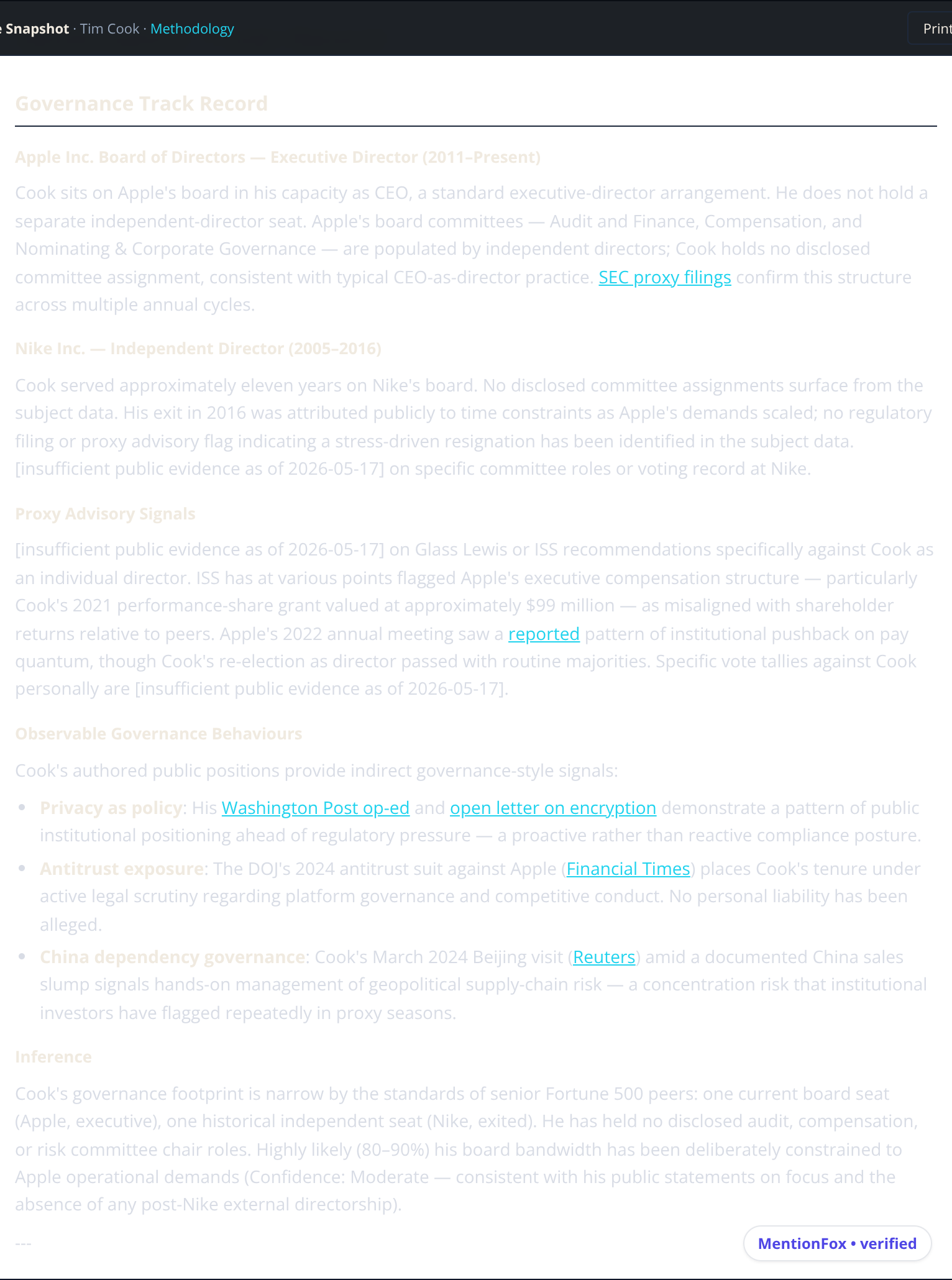
Board and governance history is the section that predicts the future. A candidate who sat on a board during a restatement, a mass layoff, or a governance dispute is not disqualified — but how they acted, and whether they disclosed it, is exactly what you are hiring for. The record of that conduct is public in filings, proxy statements, and press coverage.
What financial-integrity and legal signals matter?
Check for regulatory actions, bankruptcies tied to entities the candidate controlled, and civil litigation via CourtListener. For roles touching finance, SEC litigation releases and DOJ records surface enforcement history a resume will never volunteer. Where the role touches investors, the FINRA BrokerCheck system is a further public record.
Integrity signals are cumulative. One old dispute is noise; a pattern of entities that ended in litigation, unpaid obligations, or regulatory action is a governance risk you must price into the decision. The base rate matters here: occupational-fraud research from the ACFE consistently finds that a significant share of fraud is committed by people in positions of trust and authority — which is precisely the seat you are filling.
How do you run compliant, useful reference checks?
Executive references must be consent-based, and where a third-party screener is used, FCRA-compliant — disclosure, written consent, and an adverse-action process if you decline based on the report. Beyond the offered names, seek people who reported to the candidate; subordinates observe judgment and integrity that peers and boards do not.
The best predictor of future board behavior is past board behavior. Ask specifically about a crisis the candidate presided over and how disclosure was handled. As Warren Buffett's test for hires puts it, you screen first for "integrity" — "if they don't have the first, the other two will kill you" — and a former direct report is the person most likely to tell you the truth about it.
What does an executive suitability assessment cover?
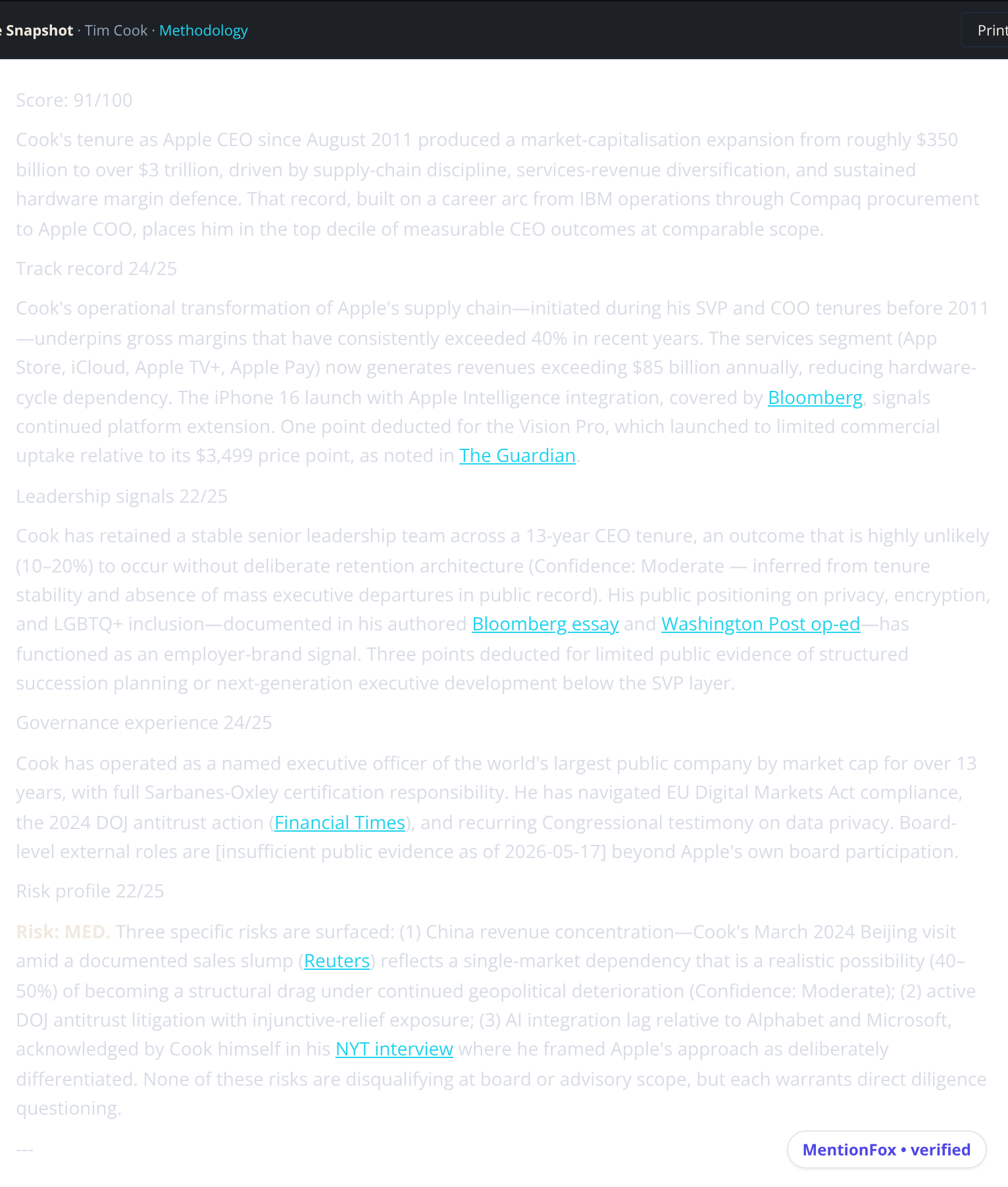
A structured suitability assessment maps the candidate against the specific mandate: the strategic challenge, the stage of the company, and the governance environment they are entering. A leader who excelled scaling a hypergrowth company may be poorly matched to a turnaround, and vice versa. The evidence — their documented track record across comparable situations — tells you which pattern they fit.
Suitability is not a single score; it is a set of honest ✓/partial/✗ reads across the dimensions that matter for this seat. A report that returns a clean sweep of strengths is a red flag, not a reassurance — every real executive has a documented weakness, and the useful assessment names it.
How do you read governance track record under stress?
Governance conduct under stress is the highest-signal, hardest-to-fake evidence about a senior hire. Pull the moments that tested them: a restatement, an activist campaign, a major layoff, a regulatory inquiry. What they did — and what they disclosed, and when — is on the record in filings and coverage, and it forecasts how they will behave on your board's worst day.
The pattern matters more than any single episode. A candidate who repeatedly presided over governance failures without accountability is telling you something true; so is one who navigated a crisis transparently and kept the organization intact. This is the section boards most often skip and most often regret skipping.
How do you handle legal and litigation history proportionately?
Legal history requires calibration, not reflex. A single old civil dispute is common and rarely disqualifying; a pattern of litigation involving fiduciary duty, fraud, or unpaid obligations is a different signal. Use CourtListener and public dockets to separate noise from pattern, and weigh recency and role.
The goal is proportionality: surface everything, disqualify only on what genuinely bears on the seat. An honest legal-history section distinguishes a contract dispute from a breach of fiduciary duty, because conflating them either scares a board off a strong hire or waves through a real risk.
What separates a strong hire from a risky one?
A strong senior hire shows a consistent public record, governance history that reads as accountable under stress, a documented suitability match for the actual mandate, and references — especially from former reports — that volunteer specifics. A risky one shows title inflation, litigation clusters, a suitability profile stretched to fit the role, or references that speak only in generalities.
The goal is not a spotless candidate; it is an honest, legible one whose worst day you can predict before you seat them. As the governance maxim holds, culture is set at the top — so the person you seat is the culture you are choosing.
How do you verify credentials and education claims?
Education and credential claims are among the most-fabricated items on a senior resume, and among the easiest to verify. Degrees can be confirmed with the issuing institution or through services like the National Student Clearinghouse; professional licenses and certifications each have a public registry. A candidate who resists a routine degree verification is answering the question for you.
Weigh credentials proportionately to the role. For most executive seats, judgment and track record matter more than a specific degree, so a credential embellishment is significant less for the qualification it inflates than for the honesty it reveals. A leader who padded a credential they did not need is telling you how they treat the truth when it is convenient.
What do compensation and conflict-of-interest signals show?
For public-company roles, executive compensation and related-party transactions are disclosed in proxy statements filed with the SEC, and they reveal how a leader has been paid and whether they have sat on both sides of a deal. Undisclosed conflicts — a supplier relationship, a family entity, an outside board seat that competes — are exactly the governance risks a board is charged with catching before they become a headline.
Map the candidate's outside interests before you seat them. Occupational-fraud research from the ACFE consistently finds that trusted insiders with undisclosed conflicts account for a meaningful share of losses. A clean, fully disclosed set of outside interests is reassuring; a pattern of conflicts that surfaced only under scrutiny is the opposite.
How do you scope the check to the seat and the risk?
Not every seat warrants the same depth. A board director with audit-committee responsibilities, a CFO with signing authority, and a divisional VP each carry different risk, and the check should scale to it. Scoping the diligence to the actual authority of the role keeps it proportionate, compliant, and focused on the signals that matter for this seat.
Document the scope before you start. A written diligence plan — what you will verify, from which sources, under what consent — protects the process legally and keeps it from drifting into irrelevant personal territory. The goal is a defensible, seat-appropriate check, not a fishing expedition.
How do you check regulated-industry and licensing records?
For roles in regulated industries, the public record is unusually rich. Financial-services leaders appear in FINRA BrokerCheck and the SEC's Investment Adviser records; healthcare executives in state licensing boards and federal exclusion lists; attorneys in state bar registries. Each is a public, authoritative check that a resume will not volunteer, and a lapse or disciplinary action there is a material signal for a seat with regulatory exposure.
Match the registry to the mandate. A CFO's history with securities regulators matters more than an old parking of a license; a healthcare board member's exclusion history matters more than an unrelated civil dispute. The discipline is knowing which public registry governs the risk of the specific seat, and checking it directly rather than trusting a summary.
What role do culture fit and leadership style play?
Skills get a candidate onto the shortlist; leadership style decides whether they succeed once seated. Executive-search research consistently attributes senior-hire failures less to competence than to fit — with the culture, the board, and the moment. A leader whose documented style is command-and-control may struggle on a consensus board, however capable, and the reverse is equally true.
Read style from the record, not the interview. How a candidate communicated during a crisis, how they were described by those who worked under them, and how they handled dissent are all documented in coverage and surfaced in references. As the governance maxim holds, boards hire for competence and fire for fit — so the fit read, done honestly up front, is where the diligence pays for itself.
How do you compress executive diligence into a board verdict?
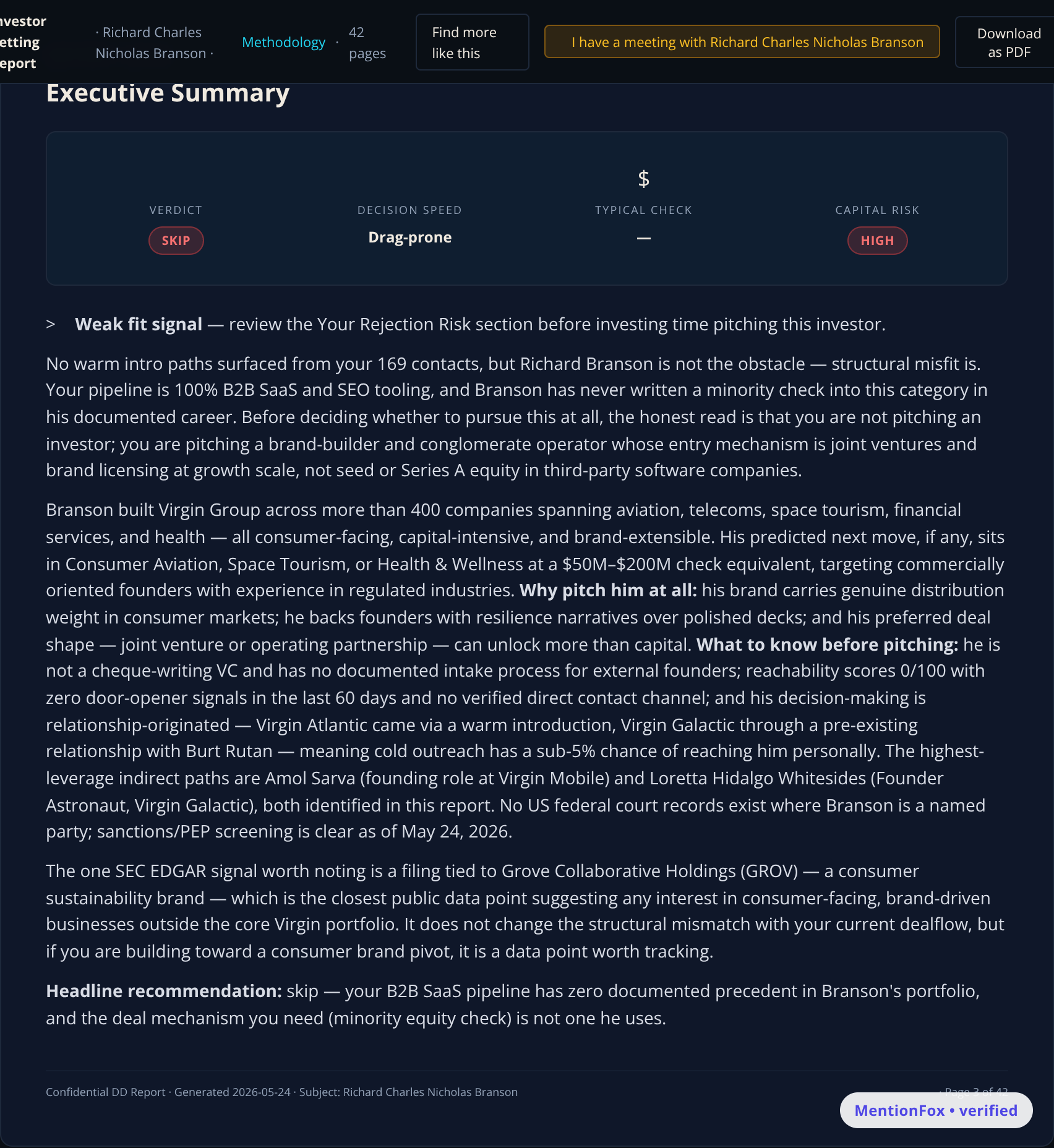
Distill the evidence into a one-page verdict a board can act on: verified spine, governance conduct, integrity signals, suitability fit, and reference signal, each tied to its source. The verdict must be able to say "not for this seat" — a report that only affirms is theatre.
Budget a focused day for the public-record and filings work, plus two to three days of calendar time for consent-based reference calls. Have the evidence assembled before the board is emotionally committed to a candidate, because at the senior level the sunk cost of a search biases the final read.
Frequently asked questions
Do I need consent to background-check an executive?
Yes. If you use a third-party screening company, the U.S. Fair Credit Reporting Act requires disclosure and written consent, plus an adverse-action process if you decline based on the report. Verifying public filings yourself is separate, but consent-based process remains best practice.
What is the most overlooked executive check?
Governance history — how the candidate behaved on a board during a crisis, restatement, or layoff, and what they disclosed. It predicts future conduct better than any credential and is documented in filings and coverage.
Who gives the most honest executive reference?
Former direct reports. Subordinates observe judgment and integrity under pressure that peers and boards rarely see, and they are more likely to name a genuine weakness the candidate's chosen references will soften.
How often do senior external hires fail?
Executive-search research puts the failure or early-departure rate for senior external hires at an uncomfortably high minority within the first year and a half, which is exactly why board-grade diligence pays for itself.
Are title and tenure claims reliable?
Often inflated, and at the senior level subtly so. Cross-check every senior title and date against company filings and dated announcements; a title that appears nowhere in the record is a flag to resolve before proceeding.
How should I weigh an old lawsuit?
Proportionately. A single old civil dispute is common and rarely disqualifying; a pattern involving fiduciary duty, fraud, or unpaid obligations is a real signal. Separate noise from pattern using public dockets, weighing recency and role.
Sources & evidence
- SEC EDGAR — officers and directors of public companies
- FTC — Fair Credit Reporting Act guidance
- CourtListener — civil litigation records
- SEC — litigation releases
- U.S. Department of Justice — enforcement records
- FINRA BrokerCheck — regulated-role records
- ACFE — occupational fraud research
- SEC — filings, proxies, and governance records
MentionFox — Evidence-backed sales intelligence and due diligence engine.
Research a person, investor, founder, or firm before the meeting: verified public-record evidence, a one-page dossier, and every claim cited.
Try MentionFox free →Cite this guide
Referencing this paper? Copy the citation below. Every claim here is sourced, so it holds up.
Referenced this in your writing? Get featured →
Add the link to your piece. We verify that your page links back here, then queue it for review — no account needed. Approved reports appear in the Featured Field Reports on the matching hub.