How to Research Anyone Before an Important Meeting
To research anyone before an important meeting, verify who they are and their current role, map their public track record and recent statements, note shared context, and compress it into a one-page brief you can scan beforehand. Walking in informed — with sourced facts, not guesses — changes the outcome of every consequential conversation.
Why does pre-meeting research change the outcome?
People decide quickly whether you are prepared. Behavioral research on first impressions finds that judgments form within seconds and are sticky thereafter — the American Psychological Association has documented how early impressions anchor later evaluation. Arriving with specific, accurate context signals respect and shifts a meeting from cold to warm before you have made your case.
The information is public; the discipline is assembling it into something usable in the room. A generic opener wastes the one advantage you controlled — the half hour of preparation the other side did not know you did. As the old sales maxim holds, the meeting is won or lost before it starts.
How do you verify identity and current role?
Confirm the basics first: full name, current title, and company, cross-checked against more than one source. Professional profiles, company sites, and for public-company officers the SEC's EDGAR records establish the verifiable spine. Same-name mismatches are common — the U.S. Census Bureau lists tens of thousands of surnames shared by large numbers of people — so never build a brief on an unverified identity.
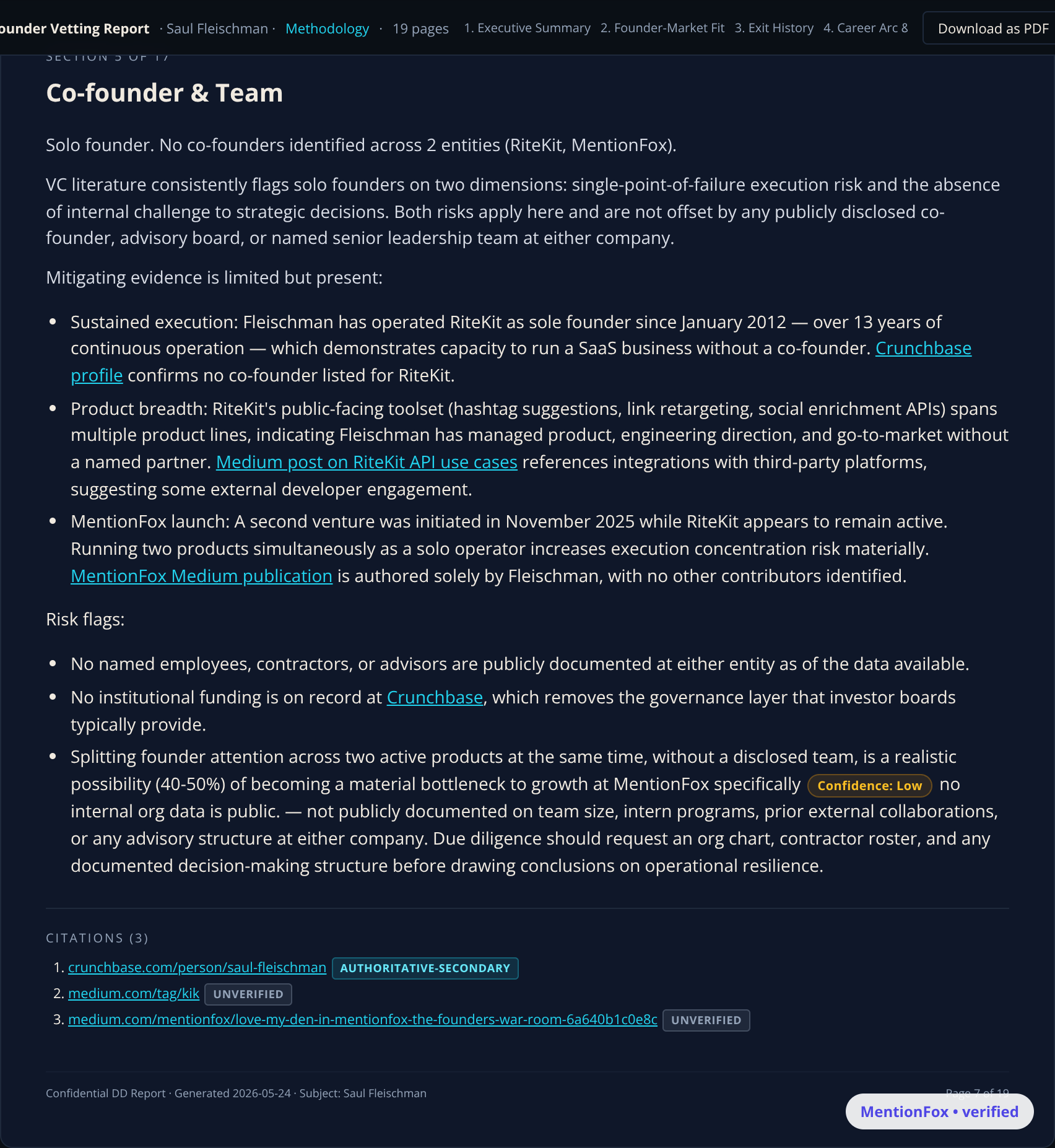
"Empty is better than wrong" is the governing rule of people research: a fact you cannot verify is left out, not guessed. A single confident error in the room — the wrong company, an outdated title, a conflated namesake — costs more than a thinner brief, because it tells the other side your preparation cannot be trusted.
How do you map someone's career arc and track record?
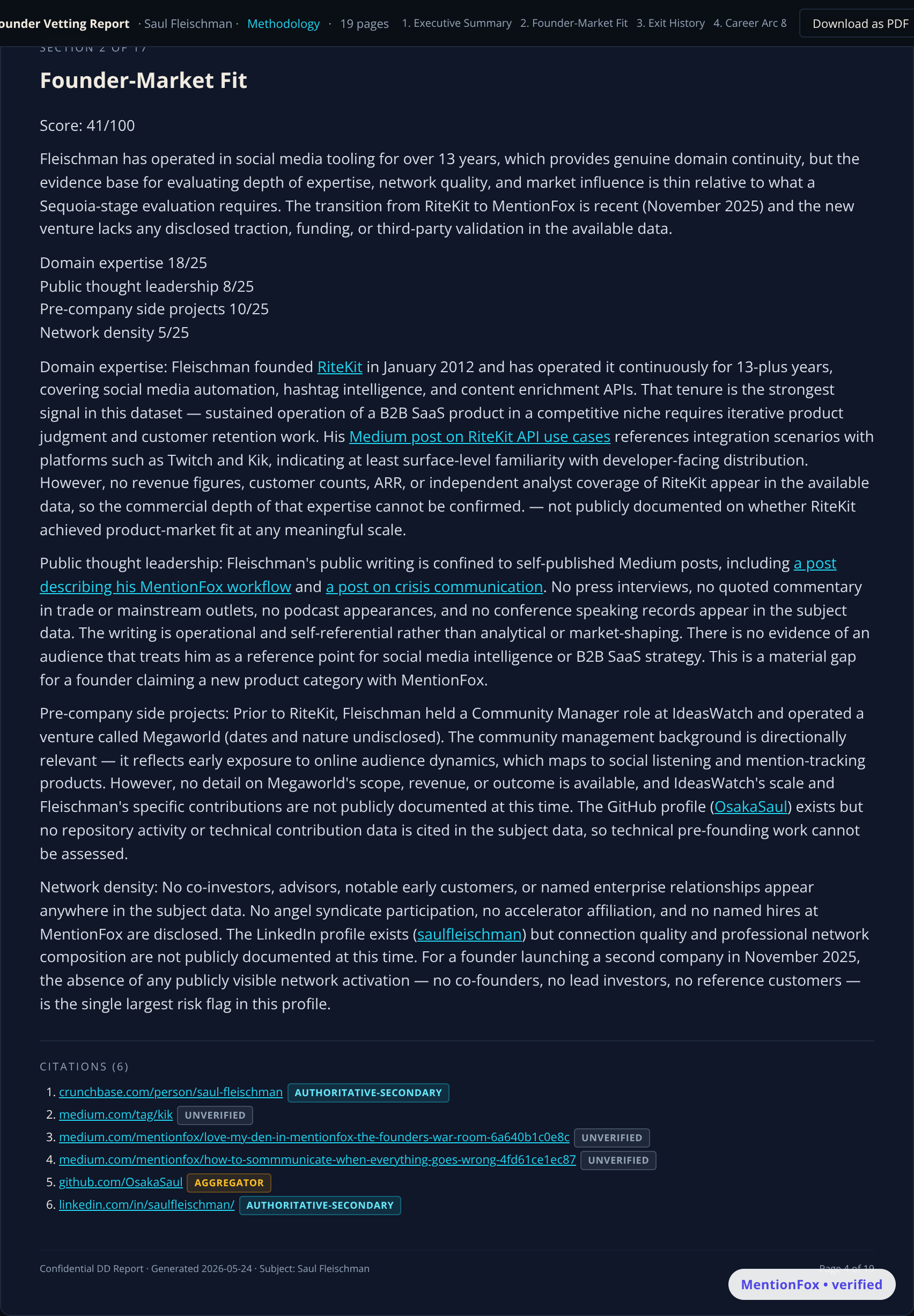
Assemble the person's career arc, notable work, and the throughline that connects them. Patterns emerge: what they build, how they move between roles, what they return to. Those patterns are your hooks for a substantive conversation and your guide to what they value. A career arc read closely often reveals more about how someone will decide than any single current fact.
The arc also tells you what to avoid. Someone who left a company on difficult terms, or who has publicly moved away from a topic, gives you a map of the subjects that will help and the ones that will chill the room. This is the section a real dossier assembles from sourced public history rather than assumption.
How do you read recent public statements and current concerns?
Recency matters most. What someone said last month — in a talk, a post, an interview — is a far better conversation opener than a bio line from five years ago, and it tells you what is currently on their mind. Map their recent public statements for current concerns, active projects, and stated priorities, because meeting someone where they are today is what makes a conversation feel intelligent rather than researched.
Current concerns are also negotiation intelligence. A person openly worried about a hiring gap, a launch, or a market shift has told you what a well-aimed offer should address. The public record of what someone is thinking about now is the highest-value, most perishable part of a brief.
What shared context should you look for?
Map mutual connections, overlapping employers or schools, and shared communities. A warm reference or a genuine common thread lowers the temperature of any first meeting — the Harvard Business Review has repeatedly documented how shared background and warm introductions raise trust and response rates. The goal is a real connection point, not a manufactured one.
Note it lightly. Overplaying a tenuous link reads as research theatre and can backfire; a single authentic point of overlap is enough to establish that you are not a stranger. The difference between "we both know Sarah" and "I noticed we both worked at Acme in 2019" is the difference between a bridge and a pretext.
How do you keep people research ethical and accurate?
Ethical people research stays inside the public record and the person's own disclosures, and it respects context. Assembling someone's public professional history for a business meeting is ordinary diligence; compiling sensitive personal detail is not, and it can violate both norms and, depending on jurisdiction, law. The FTC and privacy regimes like the GDPR draw meaningful lines around how personal data may be gathered and used.
Accuracy is the other half of ethics. A brief built on a misidentified namesake or an unverified rumor is not just useless — it can be defamatory or embarrassing. The discipline of "empty is better than wrong" protects both the subject and you.
How do you compress it into a usable one-page brief?
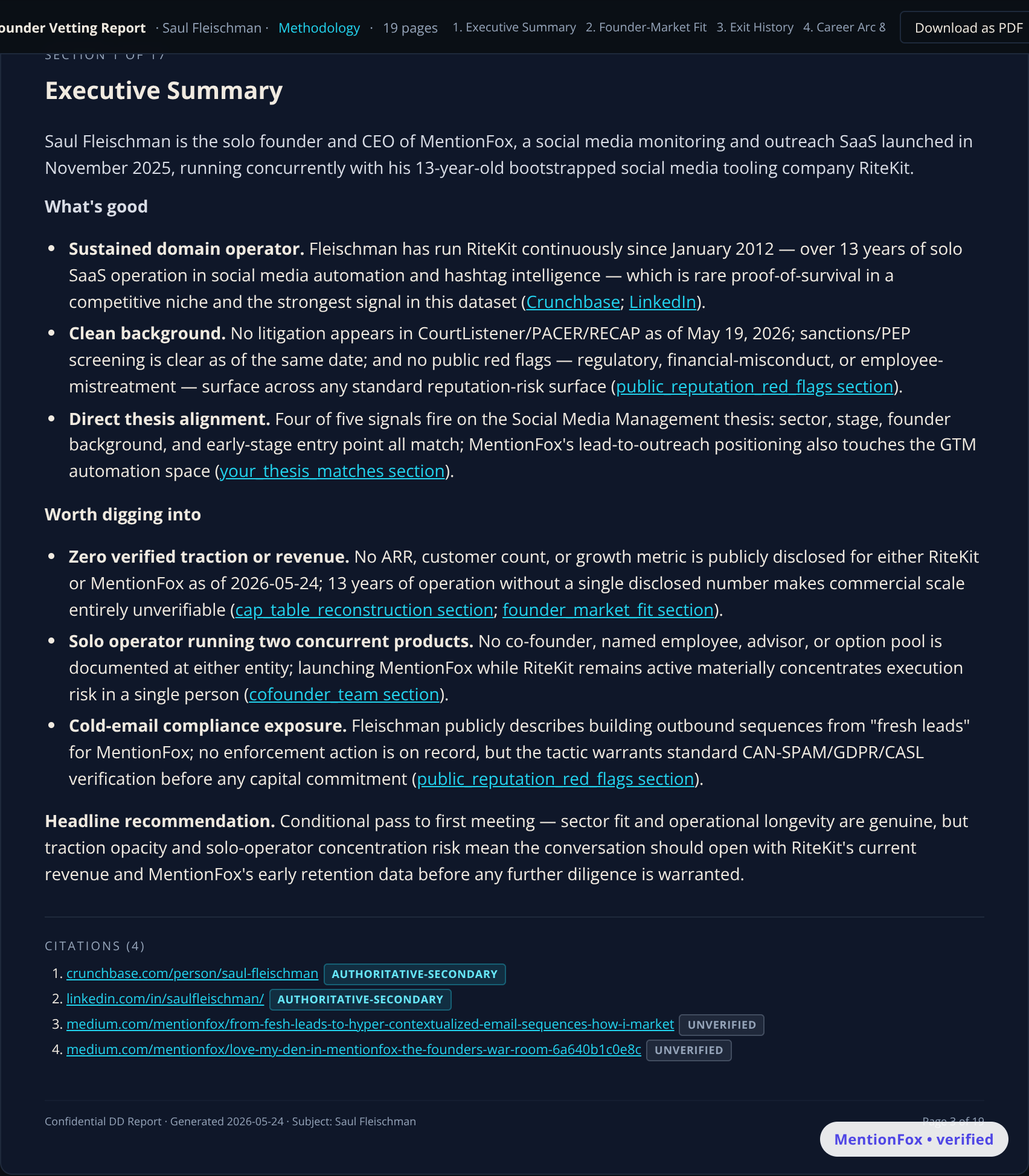
Distill everything to a single page: who they are, what they are working on now, what they likely want from the meeting, three specifics you can reference, and two smart questions to ask. That density is what turns hours of research into a thirty-second pre-read you can actually use under the pressure of a live conversation.
A good brief is scannable in the elevator. If you cannot glance at it and walk in ready, it is a dossier, not a brief — and dossiers do not help you in the room. The compression is the product; the research is just the raw material.
How do you research a company alongside the person?
A person rarely matters in isolation; they matter as a decision-maker inside an organization. Research the company alongside the individual: its recent news, funding, product direction, and public priorities via Crunchbase and, for public companies, SEC filings. Knowing what the company is trying to do this quarter tells you what the person in the meeting is actually measured on.
The intersection of person and company is where the useful angle lives. A decision-maker at a company that just raised is in growth mode; one at a company that just missed a quarter is in defense. The same individual will weigh the same proposal differently depending on the organizational moment — and that moment is public if you look for it.
How do you find and verify contact details ethically?
When the goal is to reach someone, use their stated professional channels — the company site, a verified profile, an outlet or team page — not guessed or scraped personal addresses. Ethical, accurate sourcing is also practical: verified professional contacts reach the person and preserve the relationship, while scraped ones bounce, land in spam, and signal exactly the wrong thing.
Respect the boundary between professional and personal. Reaching a decision-maker through the channel they publish for business is ordinary; routing around it to a private address is not, and privacy regimes like the GDPR increasingly treat that distinction as a legal one, not just a courtesy.
How do you keep a brief current for recurring relationships?
For people you will meet repeatedly — investors, partners, key customers — a one-time brief decays. Maintain a living, one-page view that you refresh before each interaction: what has changed since you last spoke, what they have said publicly, and what they are working on now. Recency is the perishable, highest-value part of any brief, and a stale one is worse than none because it makes you sound out of touch.
The discipline compounds. Operators who keep a light, current view of the handful of people who matter most walk into every meeting already oriented, while everyone else re-researches from scratch or improvises. The brief is not a one-time artifact; for the relationships that matter, it is a habit.
How do you tailor the brief to the type of meeting?
A brief for an investor pitch, a sales call, a partnership discussion, and a job interview are not the same document. For an investor, weight their thesis, portfolio, and check pattern; for a buyer, their role, pain, and current priorities; for a partner, the strategic fit and their organization's moment. Tailoring the brief to the meeting's purpose is what makes the preparation feel targeted rather than generic.
The structure stays constant even as the emphasis shifts: who they are, what they want, three specifics, two questions. What changes is which facts earn a place on the single page. A disciplined operator keeps the format and re-weights the content, so every brief is both familiar to produce and specific to the meeting it serves.
What tools and sources speed up a good brief?
The fastest briefs come from a small, repeatable source stack: a professional network for role and history, company sites and Crunchbase for the organization, Google Scholar or a patent search for technical depth, and recent public posts for current concerns. Knowing your sources in advance turns an hour of scattered searching into a focused pass, because you are filling a known template rather than wandering.
Purpose-built research tools compress this further by assembling the sourced sections automatically, but the discipline is the same with or without them: verify identity, map the arc, capture recency, note shared context, and compress. The tool speeds the assembly; the one-page judgment about what belongs is still yours, and it is the part that changes the meeting.
How do you use the brief in the room?
Open with a genuine, specific reference to something recent and relevant — not a recitation of facts, which reads as surveillance, but a natural signal that you know their world. Then let the questions you prepared do the work: informed questions demonstrate preparation and hand the other side the floor, which is where trust is built.
Hold the brief lightly. The goal is not to prove you did homework but to have a better conversation because you did. The best-briefed operators sound curious, not scripted — because the preparation freed them to listen instead of scrambling.
Frequently asked questions
How long should pre-meeting research take?
Aim for a focused 30 to 45 minutes that produces a one-page brief. The constraint forces you to keep only what you will actually use in the room, which is the entire point of a brief rather than a dossier.
What is the most important rule in people research?
Empty is better than wrong. Leave out anything you cannot verify; one confident error in the meeting — a wrong company, an outdated title, a conflated namesake — costs more than a thinner brief and signals your preparation cannot be trusted.
What belongs on a one-page meeting brief?
Who they are, what they are working on now, what they likely want from the meeting, three specifics you can reference, and two smart questions to ask. Compress hours of research into a thirty-second pre-read.
Is researching someone before a meeting ethical?
Yes, when it stays inside the public record and their own disclosures and is used for legitimate business context. Compiling sensitive personal detail is different and can cross legal lines under regimes like GDPR — keep it to public, professional information.
Can I do this without paid tools?
Yes. Professional profiles, company sites, public filings, and recent public statements are free. Paid tools speed up assembly, but the one-page brief — not the raw research — is what changes the meeting.
How do I use the brief without sounding like a stalker?
Reference something recent and relevant naturally, then let prepared questions carry the conversation. Reciting facts reads as surveillance; showing you understand their current world reads as respect. Hold the brief lightly and listen.
Should I research the company as well as the person?
Yes. A decision-maker matters as part of an organization, so research the company's recent news, funding, and priorities alongside the individual. Whether the company just raised or just missed a quarter changes how the same person weighs the same proposal — and that organizational moment is public if you look.
How do I keep a brief current for people I meet repeatedly?
Maintain a living one-page view you refresh before each interaction: what changed since you last spoke, what they said publicly, and what they are working on now. Recency is the perishable, highest-value part of a brief, so a stale one is worse than none because it makes you sound out of touch.
Sources & evidence
- SEC EDGAR — public-company officers and directors
- U.S. Census Bureau — surname and population data
- American Psychological Association — first-impression research
- Harvard Business Review — trust and warm introductions
- U.S. Federal Trade Commission — data-use guidance
- GDPR — personal-data protection rules
- Google Scholar — publication and citation record
- CourtListener — public legal records
MentionFox — Evidence-backed sales intelligence and due diligence engine.
Research a person, investor, founder, or firm before the meeting: verified public-record evidence, a one-page dossier, and every claim cited.
Try MentionFox free →Cite this guide
Referencing this paper? Copy the citation below. Every claim here is sourced, so it holds up.
Referenced this in your writing? Get featured →
Add the link to your piece. We verify that your page links back here, then queue it for review — no account needed. Approved reports appear in the Featured Field Reports on the matching hub.