How to Run Due Diligence on a Founder Before You Invest
To run due diligence on a founder, verify four things before you wire: their real operating track record, honest founder-market fit, a clean cap table and equity history, and reference calls with people who worked under them — including one from a company that failed. At seed, founder risk, not market risk, is what kills most bets.
Why is founder diligence the highest-leverage check an investor makes?
Early-stage venture is a power-law business. The Crunchbase and PitchBook datasets both show a handful of deals returning most of a fund, and U.S. Bureau of Labor Statistics business-survival data finds roughly 20% of new businesses fail in year one and about 50% by year five. At seed, the product is barely evidence — the founder is the asset you are underwriting.
The famous framing from investor Marc Andreessen sets the stakes: "The number one company-killer is lack of market." But at the earliest stage, before the market has spoken, the founder's judgment is the only proxy you have for whether that market will ever be found. That is why disciplined investors spend more time on the person than the deck — and why skipping it is the most expensive shortcut in the asset class.
What are the four questions founder due diligence must answer?
Effective founder diligence answers four questions in order: does the operating record support the story; is there a genuine, specific founder-market fit; is the cap table clean; and what do people who worked under this founder say about their conduct under stress. Skip any one and you are guessing on the variable most likely to end the investment.
Each question maps to public or semi-public evidence. Prior roles and raises are in filings and announcements; founder-market fit is legible from the founder's own history; cap-table health is reconstructable; and conduct is knowable through references you source yourself. The work is assembly before the term sheet, not archaeology after the board seat.
How do you verify a founder's operating track record?
Start with the verifiable spine: past titles, tenures, prior fundraises, and any exits. SEC EDGAR Form D filings are a public record of prior raises, and company announcements plus Crunchbase corroborate the timeline. Where a founder claims traction, ask for the raw numbers and a data-room export — not a screenshot, which surveys of investors repeatedly flag as the most-manipulated artifact in a pitch.
Resume inflation is common enough that it is a base rate, not an exception: background-screening studies routinely find that a large share of resumes contain at least one material discrepancy. Cross-check every senior claim against the record. A "Head of" title that appears in no filing, press mention, or LinkedIn history is a flag to resolve before you proceed, not a detail to accept on trust.
How do you assess founder-market fit honestly?
Founder-market fit is the qualitative half of the decision and the hardest to fake. Look for a credible, specific reason this person is the one to build this — lived experience of the problem, deep domain access, or a distribution advantage — not a generic ambition to disrupt a category they discovered last quarter. As Paul Graham has written, "The mistakes you make in a startup are mostly mistakes of omission" — and the omission that most often shows up later is a founder who never truly understood the customer.
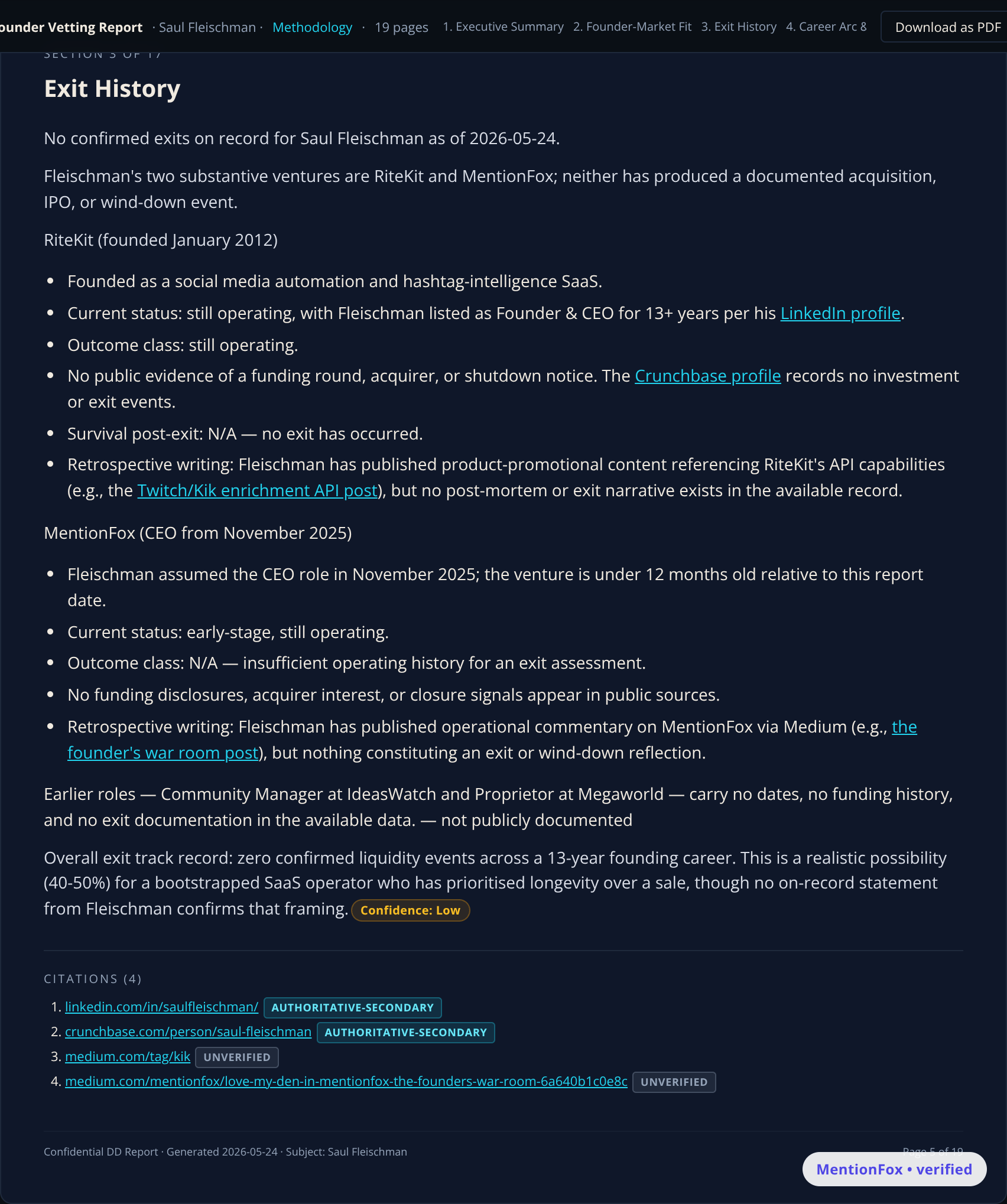
The signal is in the founder's history. A founder who spent years inside the problem space compounds faster than a talented outsider, and their network becomes the company's early distribution. This is the section where the dossier earns its keep: assembling the career arc, the domain footprint, and the public statements that reveal whether the fit is real or narrated.
What does a founder's exit and equity history tell you?
Exit history is not only about wins. How a founder behaved in a wind-down — whether employees and early investors were treated fairly, whether the cap table stayed clean — is the single best predictor of how your downside will be handled. Given that a majority of venture-backed companies never return capital, the downside is the likely path, and the founder's past conduct in it is your best forecast.
A reconstructed cap table across prior ventures surfaces dilution patterns, undisclosed side letters, secondary sales taken before a raise, and option pools re-priced under pressure. None is disqualifying alone. A pattern — especially repeated founder-on-founder disputes or quiet equity re-slicing — is a governance signal you must price into the deal, because the same habits will govern your investment.
How do you read a founder's team and co-founder dynamics?
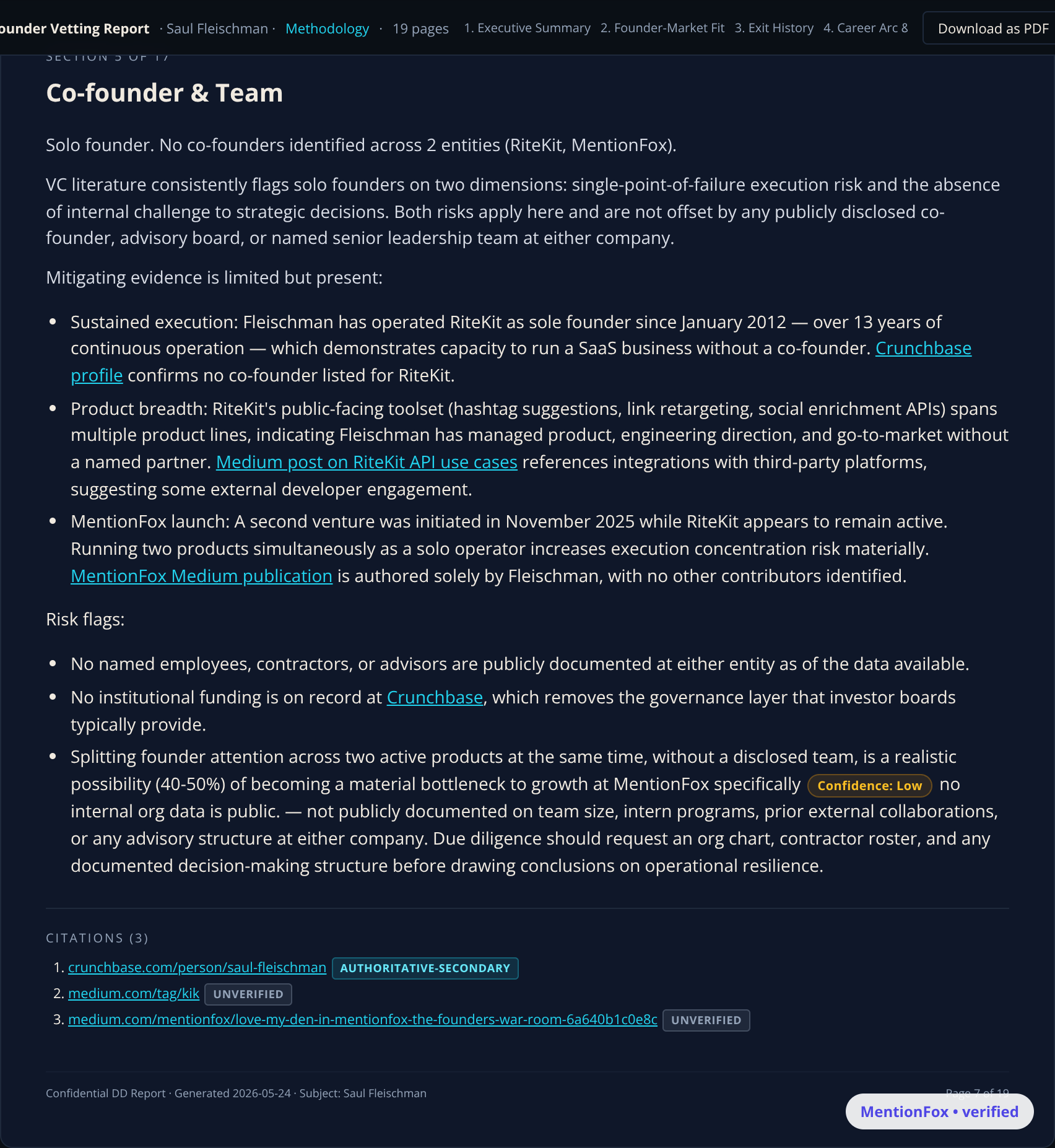
Co-founder conflict is one of the most-cited causes of early-stage failure in post-mortem surveys, and it is largely knowable in advance. Map the founding team's history together: how long they have worked as a unit, whether roles and equity are clearly divided, and whether there is a single accountable decision-maker. A 50/50 split with no tie-breaker and no prior working relationship is a structural risk, not a red flag you can coach away later.
References from former teammates — not just the founder's chosen names — reveal whether the team functions under pressure. Ask specifically about a moment the plan slipped: who made the call, and how the team held. A founding team that has already survived one crisis together is worth a meaningful premium over a talented set of strangers.
How do you run reference checks that actually surface risk?
Ask the founder for references, then find your own — specifically a former colleague or co-founder from a company that did not work out. Investors who back great founders repeatedly make the same point: the useful signal comes from the calls you source yourself, not the ones handed to you. As Warren Buffett has said of hiring, you look for "integrity, intelligence, and energy; and if they don't have the first, the other two will kill you" — a test that applies exactly to founders.
Frame questions behaviorally. "Tell me about a time this founder was under real pressure — what did they do?" surfaces judgment that a polished pitch conceals. A founder's conduct under stress, not their charisma in the room, is the variable you are underwriting, and a former direct report will tell you the truth a peer will soften.
What are the red flags that should slow a deal down?
Three red flags recur: reluctance to provide references from failed ventures, inconsistencies between the founder's public narrative and the verifiable record, and control terms that concentrate power without accountability. The FTC and civil court records via CourtListener will surface litigation and enforcement the deck omits, and SEC litigation releases catch securities issues.
A single red flag is a reason to dig, not to pass. But an accumulation — particularly around honesty and how others were treated — is the cheapest "no" you will ever write. As Ben Horowitz put it, "The hard thing isn't setting a big, hairy, audacious goal. The hard thing is laying people off when you miss the big goal" — and how a founder handled exactly that, last time, is on the record if you look.
What public records actually reveal about a founder?
The public record is deeper than most investors use. Beyond SEC filings and Crunchbase, business registrations, USPTO patent and trademark filings, and civil dockets via CourtListener together sketch a founder's real footprint — what they built, what they own, and what they have been sued over. A founder who claims deep technical work but holds no filings, contributions, or public artifacts is worth a second look.
Public statements are their own record. A founder's talks, posts, and interviews over several years reveal how their thinking has evolved and whether their story has stayed consistent. Inconsistencies between the narrated arc and the documented one are the single most useful thing the record surfaces, because they are the cheapest way to test honesty before you have any money at risk.
How do you weigh a founder's prior failures fairly?
A prior failure is not a red flag — in venture it is often a credential, because failure is the base rate. With a majority of startups not returning capital, most experienced founders have a wind-down behind them, and how they handled it is far more informative than the fact of it. The question is never "did they fail" but "how did they fail, and who did they take care of on the way down."
Distinguish an honest failure from a governance one. A founder whose company died in a hard market but who treated employees and investors fairly has learned something valuable; one who left a trail of unpaid obligations, disputes, or opacity has revealed a pattern. As the venture adage holds, you are not betting against failure — you are betting on how someone behaves when it arrives.
How do investors calibrate conviction against evidence?
The final discipline is calibration: matching your conviction to what the evidence actually supports, not to how much you like the founder. Investors talk about "reference-class forecasting" — comparing this founder to the documented outcomes of similar founders — precisely because a compelling narrative reliably outruns the base rate. The dossier exists to drag the decision back toward the evidence.
Write down what would change your mind before you fall in love with the deal. A pre-committed list of disqualifiers — an unresolved lawsuit, a reference that will not vouch, a cap-table surprise — protects you from the confirmation bias that sets in once you have decided you want to invest. The founders worth backing survive that scrutiny; the ones who cannot are the ones the scrutiny was for.
How do you turn founder diligence into a decision?
Compress the four questions into a one-page verdict that can say no: track-record confidence, founder-market fit, cap-table health, and reference signal, each with the evidence behind it. A report that can only conclude "great founder" is a brochure, not diligence. The value is in a verdict calibrated to what the evidence actually supports.
Budget a focused day for the public-record work and two to three days of calendar time for reference calls, since people answer on their own schedule. Finish before you are emotionally committed to the term sheet — because once you have talked yourself into a founder, every subsequent data point gets read as confirmation.

Frequently asked questions
What is the single most predictive founder-diligence check?
A reference call you source yourself from a former colleague at a company that failed. Founders who treat people well in a wind-down are proud of it; reluctance to offer those names is the strongest negative signal, and it is free to test.
Is market risk or founder risk bigger at seed?
At seed the product is barely evidence, so founder risk dominates the decision. Market analysis still matters, but with no traction to read, the founder's judgment and integrity are the primary variables you are underwriting.
How common is resume inflation among founders?
Common enough to treat as a base rate. Background-screening studies routinely find a large share of resumes carry at least one material discrepancy, so every senior claim should be cross-checked against filings, press, and employment history.
How long should founder due diligence take?
Budget a focused day for public-record verification and two to three days of calendar time for reference calls. Finish the evidence-gathering before you are emotionally committed to the deal, when confirmation bias sets in.
Can you vet a founder without paid databases?
Yes. SEC EDGAR, company announcements, court records via CourtListener, and direct reference calls are all free. Paid tools speed up cap-table and timeline reconstruction, but the highest-signal source — the calls — costs nothing but the ask.
What cap-table signals predict trouble?
Undisclosed side letters, secondary sales taken before a priced round, repeatedly re-priced option pools, and founder-on-founder equity disputes across prior ventures. One is noise; a pattern predicts how your equity will be treated.
Sources & evidence
- SEC EDGAR — Form D filings (prior raises)
- Crunchbase — company and funding timelines
- PitchBook — deal and return distribution data
- BLS Business Employment Dynamics — survival rates
- CourtListener — civil litigation records
- U.S. Federal Trade Commission — enforcement records
- SEC — litigation releases
- Paul Graham — essays on founders and startups
MentionFox — Evidence-backed sales intelligence and due diligence engine.
Research a person, investor, founder, or firm before the meeting: verified public-record evidence, a one-page dossier, and every claim cited.
Try MentionFox free →Cite this guide
Referencing this paper? Copy the citation below. Every claim here is sourced, so it holds up.
Referenced this in your writing? Get featured →
Add the link to your piece. We verify that your page links back here, then queue it for review — no account needed. Approved reports appear in the Featured Field Reports on the matching hub.